
Blog
Plywood Frame Cabinets: The B2B Buyer’s Guide 2026

TL;DR
I’ve seen a lot of contractors get burned by this decision. They order cabinets, the project wraps up, and then three years later the calls start coming in. Swollen doors. Loose hinges. Shelves that sag under normal dish weight. Nine times out of ten, it traces back to the cabinet material. Plywood frame cabinets don’t have that problem. They grip screws, shrug off moisture, and hold up in ways that MDF simply cannot match when buildings actually get used. This guide is for the B2B buyer who wants to get it right the first time, before the plywood frame cabinets go in.
Table of Contents
- What Are Plywood Frame Cabinets?
- Plywood vs MDF vs Solid Wood: The Real Comparison
- Which Plywood Grade Should You Specify?
- Why Plywood Wins in Commercial Environments
- Quick Comparison Table
- How to Source Plywood Frame Cabinets the Right Way
- FAQs
- Conclusion
1. What Are Plywood Frame Cabinets and Why Should B2B Buyers Care in 2026?
Last year, a contractor I know bid on a 40-unit apartment renovation in Detroit. The spec sheet just said “kitchen cabinets.” He assumed that was simple enough. It wasn’t.
The material he picked determined whether those kitchens would hold up for 25 years or need replacing before the second lease cycle. One wrong call across 40 units quietly adds up to tens of thousands in avoidable repair bills.
How Plywood Frame Cabinets Are Actually Built
So what are plywood frame cabinets, exactly? Cut open a plywood panel and you will see it immediately. Thin layers of wood, each one running a different direction than the one below it. That staggered layout is the whole trick. When stress hits the panel, it cannot travel cleanly through it because every layer is fighting back from a different angle.
The layers work against each other. Warping cannot travel through the panel the way it does in a single solid board. Swelling gets stopped before it reaches the joint.
Why the Industry Keeps Coming Back to Plywood
That is not just a design feature. It is the structural reason plywood has stayed at the top of commercial cabinet construction for so long.
The global plywood market is growing at 6% annually through 2035, mostly because of cabinet and interior construction demand. That number reflects something real. Nobody keeps specifying the same material for 40 years by accident.
2. Plywood Frame Cabinets vs MDF vs Solid Wood: The Real Comparison
Here is what most buyers already know: plywood costs more than MDF upfront. Here is what they sometimes miss: that extra cost usually pays itself back faster than expected.
The Problem With MDF in Commercial Settings
MDF has a genuinely smooth surface. For painted doors in a modern kitchen, it looks fantastic right out of the factory. Then a pipe drips under the sink. Or summer humidity pushes into the building for two months straight. That smooth MDF surface starts pulling away at the seams. A screw gets retightened and strips out because the material around it has gone soft. Nobody notices any of this during move-in. They notice it during year three when the tenant calls about a cabinet door that hangs crooked and will not close right.
Why Solid Wood Falls Short on Commercial Builds
Clients love pointing at solid wood samples in a showroom. Fair enough. But solid wood moves constantly. Summer humidity expands it. Winter dryness contracts it. In a building with commercial HVAC running every day, that movement eventually cracks joints and throws door alignment off. It also carries the highest price tag of these three options by a meaningful margin.
Where Plywood Frame Cabinets Win the Long Game
Plywood frame cabinets land in the middle on price and at the top on commercial performance. Cross-ply construction takes the hit from both moisture and physical stress in a way the other two materials just cannot match. Real-world industry data from NextDayCabinets 2026 puts properly installed plywood RTA cabinets at 20 to 30 years of commercial service life. Particle boards rarely make it past 10 to 15 under the same conditions.
Run that math across a 50-unit building. The difference between replacing cabinets once and replacing them three times over 30 years is not a small number.
3. Which Plywood Grade Should You Specify for Commercial Cabinet Projects?
Here is where most B2B buyers lose money without realizing it. They write “plywood” on the spec sheet and trust the supplier to figure out the rest. Suppliers do not always choose the best option for your project. They choose what is available and margins-friendly.
Be specific. Here is the breakdown you need:
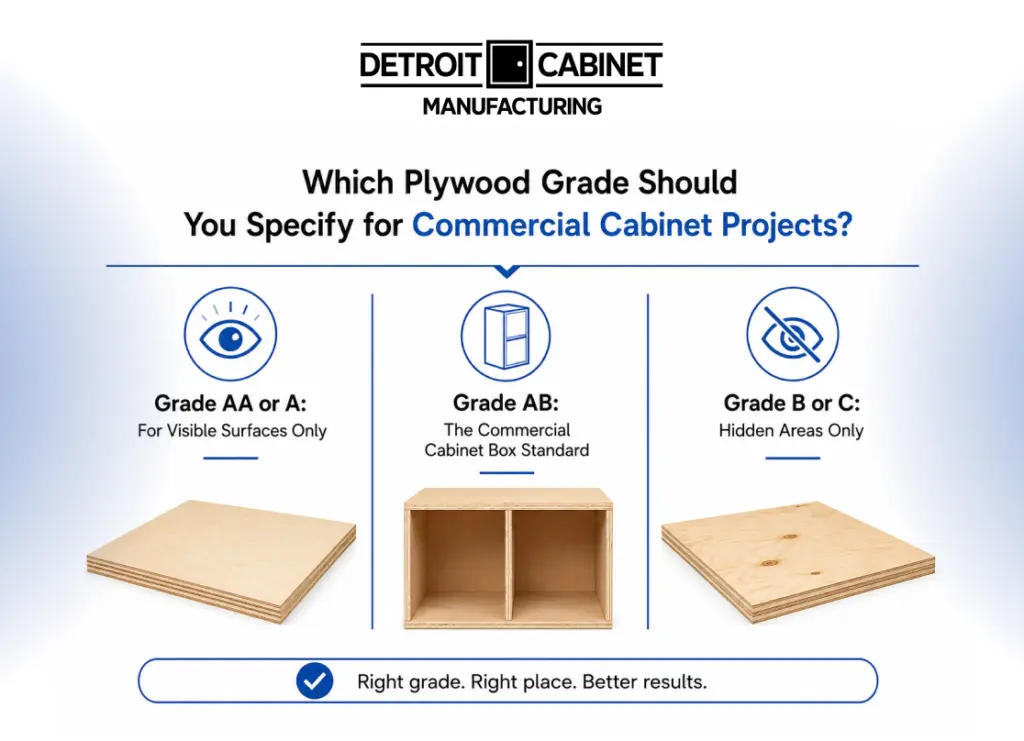
Grade AA or A: For Visible Surfaces Only
Reserve this for visible surfaces, doors, and drawer fronts. The face is defect-free and accepts any finish cleanly.
Grade AB: The Commercial Cabinet Box Standard
This is your workhorse grade for the cabinet box itself. It offers the best balance of structural strength and cost. Most experienced contractors default to AB-grade birch or maple for the cabinet carcass and nobody complains.
Grade B or C: Hidden Areas Only
Fine for hidden interior frames and non-structural components. Do not spend Grade A money where nobody will ever see the surface.
The Industry Standard Behind the Grading System
According to APA, The Engineered Wood Association, plywood panels manufactured to their grading standards deliver superior dimensional stability, excellent strength-to-weight performance, and strong resistance to impacts and environmental changes including humidity. That is the technical authority behind the grade system.
Why Baltic Birch Deserves a Separate Conversation
One more material worth calling out is Baltic birch. Its all-birch core with minimal voids makes it the professional-grade choice for drawer boxes in high-use environments. Standard hardwood plywood works for cabinet boxes. Baltic birch is what serious contractors specify for the components that take the most abuse day after day.
CARB-2 Certification: Get It Before Installation, Not After
One thing most buyers forget until it becomes a problem: CARB-2 paperwork. California Air Resources Board Phase 2 sets the limit on formaldehyde off-gassing from the adhesive in the panel. Green building projects need it. LEED projects need it. Some tenant groups ask about it directly during building inspections. Get it documented before the cabinets go in, not after someone raises the question on a walk-through.
4. Why Plywood Frame Cabinets Outperform in High-Traffic Commercial Environments
The Screw-Holding Advantage Nobody Talks About
Here is something nobody talks about in the sales pitch but every experienced installer knows. Screws in plywood stay put. Not just at installation, but two years later when a tenant’s heavy pot rack is hanging off the upper cabinet and someone retightens the hinge for the second time. MDF gives you one solid installation. After that, every adjustment is working against material that is already a little weaker than it was.
What That Weakness Looks Like Across 400 Cabinet Installations
Now scale that problem. Fifty units, eight cabinets each. That is 400 boxes, every single one carrying hinges, drawer slides, and mounting hardware. Steam from the stove, warm plates stacked on shelves, the dishwasher running twice a day. None of that is dramatic. All of it adds up. The moisture gets into the joints a little at a time, and MDF just quietly absorbs it. By the time a property manager starts getting calls, it is not one cabinet that is loose. It is a whole floor.
Plywood does not do that. It holds, and the difference shows up in your callback rate.
How Seasonal Humidity Destroys MDF Joints Over Time
Seasonal humidity does not announce itself. Summer comes, the air gets heavy, and wood-based materials respond. MDF swells. Joints shift. By the time winter rolls around and everything dries out again, the damage at the seams is already done. Plywood handles that same cycle differently. The cross-ply layers give the panel somewhere to flex without pulling apart at the joints. It is not that plywood is immune to humidity. It is that plywood is built to survive it.
Transportation and Jobsite Durability on Large Orders
Something most buyers only figure out after the truck shows up: plywood survives the trip better. Stack it, move it across a job site, bump it coming off a pallet. The edges hold. MDF under the same conditions chips at the corners and cracks along the face. On a small order that is annoying. On a 50-unit project, it becomes a conversation with your supplier about damaged goods.
Sustainability Compliance Without the Extra Paperwork Headache
Green building compliance keeps coming up on commercial projects, and plywood makes that conversation easier. FSC-certified panels satisfy LEED, WELL, and most local sustainability requirements right out of the box. Pair that with a formaldehyde-free adhesive spec and CARB-2 documentation and you are not scrambling for paperwork when the inspector walks in. You already have it filed.
5. Quick Comparison Table: Plywood vs MDF vs Solid Wood for B2B Buyers
| Feature | Plywood Frame | MDF | Solid Wood |
| Screw-Holding Strength | Excellent | Fair | Very Good |
| Moisture Resistance | Very Good | Poor | Fair |
| Commercial Lifespan | 20 to 30 years | 5 to 10 years | 15 to 25 years |
| Upfront Cost | Mid Range | Lowest | Highest |
| Total Cost of Ownership | Lowest | Highest | High |
| Best Application | Cabinet boxes, commercial builds | Painted doors, dry interiors | Premium visible surfaces |
| CARB-2 Available | Yes | Yes | N/A |
| FSC Certified Options | Yes | Limited | Yes |
6. How to Source Plywood Frame Cabinets for Commercial Projects
A lot of buyers do everything right on the specification side and then hand the order to a supplier they barely know. That is where things go sideways. Wrong grade ships, wrong species, no CARB-2 documentation. The cabinets go in and nobody finds out until months later. Before any bulk order lands, work through these checks.
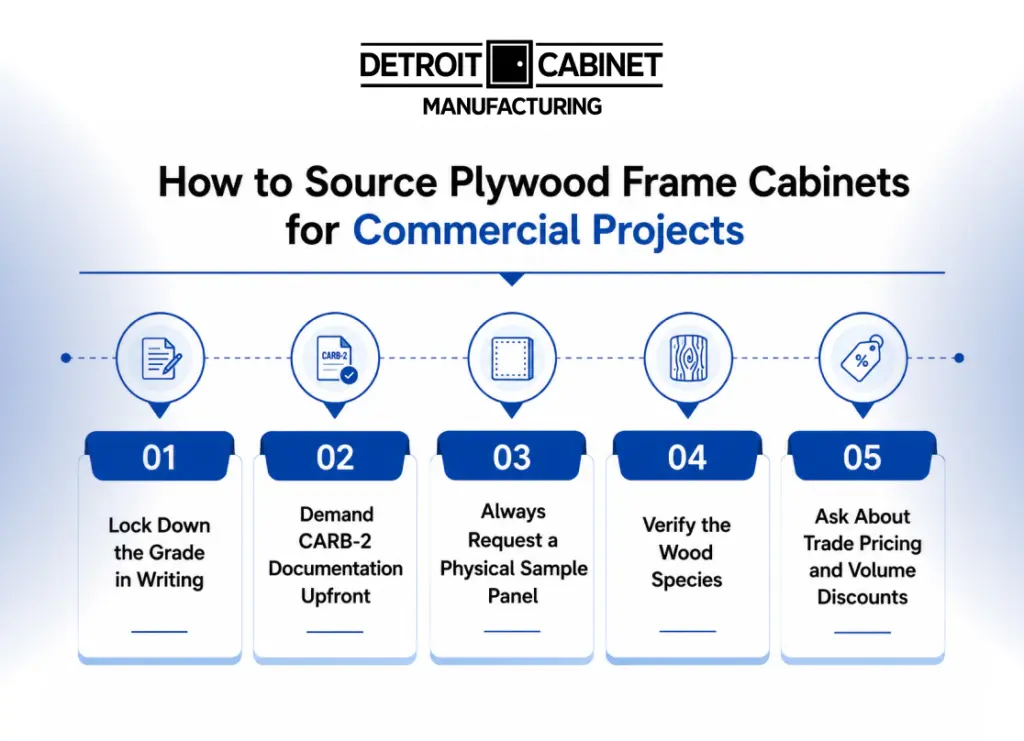
Step 1: Lock Down the Grade in Writing
Call out the exact plywood grade for the cabinet box in your order, not just the door or face. Write it down. Get confirmation back in writing.
Step 2: Demand CARB-2 Documentation Upfront
Request the CARB-2 documents before the order gets confirmed. A reputable supplier has that paperwork ready and sends it without a second thought. If there is hesitation, or if the response is vague, that is your answer right there.
Step 3: Always Request a Physical Sample Panel
Request a physical sample panel. Hold the edge. Look at the edge of that sample panel. If the core layers have gaps or voids between them, screws will not grip properly at those points. Hardware that feels solid at installation starts working loose under load. A panel worth buying has clean, tight layers with almost no visible gaps running through it.
Step 4: Verify the Wood Species
Check the wood species. Baltic birch and maple give you tighter grain and cleaner machining than lower-quality softwood cores. You can feel the difference in the sample.
Step 5: Ask About Trade Pricing and Volume Discounts
For volume orders, ask about lead times, minimum quantities, and trade pricing. A lot of wholesale plywood cabinet distributors offer 10 to 20% additional savings for professionals buying at volume, based on 2026 industry pricing benchmarks. That is worth asking about directly.
Where Detroit B2B Buyers Find Verified Cabinet Suppliers
Finding reliable, vetted cabinet suppliers in the Detroit metro area is something the Detroit Business Center’s B2B network was built for. Contractors and procurement managers use the DBC supplier directory to find commercial-grade professionals without cold-calling vendors with no track record. If you run a cabinet business yourself, listing on DBC puts your company in front of commercial buyers who are actively searching right now.
Ready to Find Verified Plywood Cabinet Suppliers in Detroit?
Stop Sourcing Blind. Connect With B2B Professionals Who Specialize in Commercial Cabinetry.
Detroit’s construction market does not slow down for suppliers who are hard to find. The contractors and developers who keep winning projects have their vendor relationships already locked in. They are not scrambling for new suppliers on a deadline.
Detroit Business Center exists to make those connections happen faster and with more confidence. Whether you need plywood cabinet suppliers, installation professionals, or material distributors in the Detroit metro area, DBC’s verified B2B network has the professionals you are looking for.
Browse the Detroit Business Center Supplier Network →
Conclusion
Plywood frame cabinets have held their place in commercial construction for decades because they earn it on the job. The cross-ply structure keeps screws tight. The layered build shrugs off moisture. A 20 to 30-year lifespan in real commercial conditions turns a slightly higher upfront cost into a lower overall ownership cost over time.
Contractors, developers, and procurement teams who think past the immediate bid already know this. They specify the grade, confirm CARB-2 compliance, and source from suppliers they have verified. The material decision is not complicated once you understand what you are actually comparing.
When you need a trusted professional network in Detroit to make those supplier connections, Detroit Business Center is where B2B relationships get built.
Frequently Asked Questions About Plywood Frame Cabinets
Are plywood frame cabinets worth the extra cost for commercial projects?
Honestly, yes, most of the time. You are paying roughly 10 to 15% more upfront compared to MDF. But over 20 to 30 years of commercial use versus 5 to 10 for MDF in the same conditions, fewer replacements and lower maintenance costs more than make up that gap. On any project with daily heavy use, the math tends to land in plywood’s favor.
What plywood thickness is standard for commercial cabinet boxes?
Three-quarter inch is the commercial default. It carries heavy loads without bowing on long shelf runs and handles the weight of commercial equipment without deflection over time.
What separates framed from frameless plywood cabinets?
With framed cabinets, there is a solid wood border running around the front of the box before the doors attach. That frame stiffens the whole structure and gives the finished kitchen a more classic, built-in feel. Frameless cabinets skip that border entirely and attach doors straight to the box, which is common in European-designed kitchens. It opens up interior access a bit, but loses some of the structural stiffness the face frame provides.
Do plywood frame cabinets hold up in high-humidity commercial spaces?
Better than MDF does, yes. The layered build handles moisture at the joints in a way MDF simply cannot. For areas with direct water contact, like under a sink or behind a laundry unit, ask specifically for moisture-resistant or BWR-grade plywood. For standard commercial kitchens and bathrooms, AB-grade birch handles typical humidity without issue.
How do you verify plywood quality before a large order?
Ask for grade certification documents and CARB-2 paperwork in writing. Then request a physical sample panel and look at the edge. Tight, consistent layers with minimal gaps mean solid screw retention and a product that will actually perform the way it is advertised.TL;DR
I’ve seen a lot of contractors get burned by this decision. They order cabinets, the project wraps up, and then three years later the calls start coming in. Swollen doors. Loose hinges. Shelves that sag under normal dish weight. Nine times out of ten, it traces back to the cabinet material. Plywood frame cabinets don’t have that problem. They grip screws, shrug off moisture, and hold up in ways that MDF simply cannot match when buildings actually get used. This guide is for the B2B buyer who wants to get it right the first time, before the plywood frame cabinets go in.
Table of Contents
What Are Plywood Frame Cabinets?
Plywood vs MDF vs Solid Wood: The Real Comparison
Which Plywood Grade Should You Specify?
Why Plywood Wins in Commercial Environments
Quick Comparison Table
How to Source Plywood Frame Cabinets the Right Way
FAQs
Conclusion
1. What Are Plywood Frame Cabinets and Why Should B2B Buyers Care in 2026?
Last year, a contractor I know bid on a 40-unit apartment renovation in Detroit. The spec sheet just said “kitchen cabinets.” He assumed that was simple enough. It wasn’t.
The material he picked determined whether those kitchens would hold up for 25 years or need replacing before the second lease cycle. One wrong call across 40 units quietly adds up to tens of thousands in avoidable repair bills.
How Plywood Frame Cabinets Are Actually Built
So what are plywood frame cabinets, exactly? Cut open a plywood panel and you will see it immediately. Thin layers of wood, each one running a different direction than the one below it. That staggered layout is the whole trick. When stress hits the panel, it cannot travel cleanly through it because every layer is fighting back from a different angle.
The layers work against each other. Warping cannot travel through the panel the way it does in a single solid board. Swelling gets stopped before it reaches the joint.
Why the Industry Keeps Coming Back to Plywood
That is not just a design feature. It is the structural reason plywood has stayed at the top of commercial cabinet construction for so long.
The global plywood market is growing at 6% annually through 2035, mostly because of cabinet and interior construction demand. That number reflects something real. Nobody keeps specifying the same material for 40 years by accident.
2. Plywood Frame Cabinets vs MDF vs Solid Wood: The Real Comparison
Here is what most buyers already know: plywood costs more than MDF upfront. Here is what they sometimes miss: that extra cost usually pays itself back faster than expected.
The Problem With MDF in Commercial Settings
MDF has a genuinely smooth surface. For painted doors in a modern kitchen, it looks fantastic right out of the factory. Then a pipe drips under the sink. Or summer humidity pushes into the building for two months straight. That smooth MDF surface starts pulling away at the seams. A screw gets retightened and strips out because the material around it has gone soft. Nobody notices any of this during move-in. They notice it during year three when the tenant calls about a cabinet door that hangs crooked and will not close right.
Why Solid Wood Falls Short on Commercial Builds
Clients love pointing at solid wood samples in a showroom. Fair enough. But solid wood moves constantly. Summer humidity expands it. Winter dryness contracts it. In a building with commercial HVAC running every day, that movement eventually cracks joints and throws door alignment off. It also carries the highest price tag of these three options by a meaningful margin.
Where Plywood Frame Cabinets Win the Long Game
Plywood frame cabinets land in the middle on price and at the top on commercial performance. Cross-ply construction takes the hit from both moisture and physical stress in a way the other two materials just cannot match. Real-world industry data from NextDayCabinets 2026 puts properly installed plywood RTA cabinets at 20 to 30 years of commercial service life. Particle boards rarely make it past 10 to 15 under the same conditions.
Run that math across a 50-unit building. The difference between replacing cabinets once and replacing them three times over 30 years is not a small number.
3. Which Plywood Grade Should You Specify for Commercial Cabinet Projects?
Here is where most B2B buyers lose money without realizing it. They write “plywood” on the spec sheet and trust the supplier to figure out the rest. Suppliers do not always choose the best option for your project. They choose what is available and margins-friendly.
Be specific. Here is the breakdown you need:
Grade AA or A: For Visible Surfaces Only
Reserve this for visible surfaces, doors, and drawer fronts. The face is defect-free and accepts any finish cleanly.
Grade AB: The Commercial Cabinet Box Standard
This is your workhorse grade for the cabinet box itself. It offers the best balance of structural strength and cost. Most experienced contractors default to AB-grade birch or maple for the cabinet carcass and nobody complains.
Grade B or C: Hidden Areas Only
Fine for hidden interior frames and non-structural components. Do not spend Grade A money where nobody will ever see the surface.
The Industry Standard Behind the Grading System
According to APA, The Engineered Wood Association, plywood panels manufactured to their grading standards deliver superior dimensional stability, excellent strength-to-weight performance, and strong resistance to impacts and environmental changes including humidity. That is the technical authority behind the grade system.
Why Baltic Birch Deserves a Separate Conversation
One more material worth calling out is Baltic birch. Its all-birch core with minimal voids makes it the professional-grade choice for drawer boxes in high-use environments. Standard hardwood plywood works for cabinet boxes. Baltic birch is what serious contractors specify for the components that take the most abuse day after day.
CARB-2 Certification: Get It Before Installation, Not After
One thing most buyers forget until it becomes a problem: CARB-2 paperwork. California Air Resources Board Phase 2 sets the limit on formaldehyde off-gassing from the adhesive in the panel. Green building projects need it. LEED projects need it. Some tenant groups ask about it directly during building inspections. Get it documented before the cabinets go in, not after someone raises the question on a walk-through.
4. Why Plywood Frame Cabinets Outperform in High-Traffic Commercial Environments
The Screw-Holding Advantage Nobody Talks About
Here is something nobody talks about in the sales pitch but every experienced installer knows. Screws in plywood stay put. Not just at installation, but two years later when a tenant’s heavy pot rack is hanging off the upper cabinet and someone retightens the hinge for the second time. MDF gives you one solid installation. After that, every adjustment is working against material that is already a little weaker than it was.
What That Weakness Looks Like Across 400 Cabinet Installations
Now scale that problem. Fifty units, eight cabinets each. That is 400 boxes, every single one carrying hinges, drawer slides, and mounting hardware. Steam from the stove, warm plates stacked on shelves, the dishwasher running twice a day. None of that is dramatic. All of it adds up. The moisture gets into the joints a little at a time, and MDF just quietly absorbs it. By the time a property manager starts getting calls, it is not one cabinet that is loose. It is a whole floor.
Plywood does not do that. It holds, and the difference shows up in your callback rate.
How Seasonal Humidity Destroys MDF Joints Over Time
Seasonal humidity does not announce itself. Summer comes, the air gets heavy, and wood-based materials respond. MDF swells. Joints shift. By the time winter rolls around and everything dries out again, the damage at the seams is already done. Plywood handles that same cycle differently. The cross-ply layers give the panel somewhere to flex without pulling apart at the joints. It is not that plywood is immune to humidity. It is that plywood is built to survive it.
Transportation and Jobsite Durability on Large Orders
Something most buyers only figure out after the truck shows up: plywood survives the trip better. Stack it, move it across a job site, bump it coming off a pallet. The edges hold. MDF under the same conditions chips at the corners and cracks along the face. On a small order that is annoying. On a 50-unit project, it becomes a conversation with your supplier about damaged goods.
Sustainability Compliance Without the Extra Paperwork Headache
Green building compliance keeps coming up on commercial projects, and plywood makes that conversation easier. FSC-certified panels satisfy LEED, WELL, and most local sustainability requirements right out of the box. Pair that with a formaldehyde-free adhesive spec and CARB-2 documentation and you are not scrambling for paperwork when the inspector walks in. You already have it filed.
5. Quick Comparison Table: Plywood vs MDF vs Solid Wood for B2B Buyers
Feature
Plywood Frame
MDF
Solid Wood
Screw-Holding Strength
Excellent
Fair
Very Good
Moisture Resistance
Very Good
Poor
Fair
Commercial Lifespan
20 to 30 years
5 to 10 years
15 to 25 years
Upfront Cost
Mid Range
Lowest
Highest
Total Cost of Ownership
Lowest
Highest
High
Best Application
Cabinet boxes, commercial builds
Painted doors, dry interiors
Premium visible surfaces
CARB-2 Available
Yes
Yes
N/A
FSC Certified Options
Yes
Limited
Yes
6. How to Source Plywood Frame Cabinets for Commercial Projects
A lot of buyers do everything right on the specification side and then hand the order to a supplier they barely know. That is where things go sideways. Wrong grade ships, wrong species, no CARB-2 documentation. The cabinets go in and nobody finds out until months later. Before any bulk order lands, work through these checks.
Step 1: Lock Down the Grade in Writing
Call out the exact plywood grade for the cabinet box in your order, not just the door or face. Write it down. Get confirmation back in writing.
Step 2: Demand CARB-2 Documentation Upfront
Request the CARB-2 documents before the order gets confirmed. A reputable supplier has that paperwork ready and sends it without a second thought. If there is hesitation, or if the response is vague, that is your answer right there.
Step 3: Always Request a Physical Sample Panel
Request a physical sample panel. Hold the edge. Look at the edge of that sample panel. If the core layers have gaps or voids between them, screws will not grip properly at those points. Hardware that feels solid at installation starts working loose under load. A panel worth buying has clean, tight layers with almost no visible gaps running through it.
Step 4: Verify the Wood Species
Check the wood species. Baltic birch and maple give you tighter grain and cleaner machining than lower-quality softwood cores. You can feel the difference in the sample.
Step 5: Ask About Trade Pricing and Volume Discounts
For volume orders, ask about lead times, minimum quantities, and trade pricing. A lot of wholesale plywood cabinet distributors offer 10 to 20% additional savings for professionals buying at volume, based on 2026 industry pricing benchmarks. That is worth asking about directly.
Where Detroit B2B Buyers Find Verified Cabinet Suppliers
Finding reliable, vetted cabinet suppliers in the Detroit metro area is something the Detroit Business Center’s B2B network was built for. Contractors and procurement managers use the DBC supplier directory to find commercial-grade professionals without cold-calling vendors with no track record. If you run a cabinet business yourself, listing on DBC puts your company in front of commercial buyers who are actively searching right now.
Ready to Find Verified Plywood Cabinet Suppliers in Detroit?
Stop Sourcing Blind. Connect With B2B Professionals Who Specialize in Commercial Cabinetry.
Detroit’s construction market does not slow down for suppliers who are hard to find. The contractors and developers who keep winning projects have their vendor relationships already locked in. They are not scrambling for new suppliers on a deadline.
Detroit Business Center exists to make those connections happen faster and with more confidence. Whether you need plywood cabinet suppliers, installation professionals, or material distributors in the Detroit metro area, DBC’s verified B2B network has the professionals you are looking for.
Browse the Detroit Business Center Supplier Network →
Conclusion
Plywood frame cabinets have held their place in commercial construction for decades because they earn it on the job. The cross-ply structure keeps screws tight. The layered build shrugs off moisture. A 20 to 30-year lifespan in real commercial conditions turns a slightly higher upfront cost into a lower overall ownership cost over time.
Contractors, developers, and procurement teams who think past the immediate bid already know this. They specify the grade, confirm CARB-2 compliance, and source from suppliers they have verified. The material decision is not complicated once you understand what you are actually comparing.
When you need a trusted professional network in Detroit to make those supplier connections, Detroit Business Center is where B2B relationships get built.
Frequently Asked Questions About Plywood Frame Cabinets
Are plywood frame cabinets worth the extra cost for commercial projects?
Honestly, yes, most of the time. You are paying roughly 10 to 15% more upfront compared to MDF. But over 20 to 30 years of commercial use versus 5 to 10 for MDF in the same conditions, fewer replacements and lower maintenance costs more than make up that gap. On any project with daily heavy use, the math tends to land in plywood’s favor.
What plywood thickness is standard for commercial cabinet boxes?
Three-quarter inch is the commercial default. It carries heavy loads without bowing on long shelf runs and handles the weight of commercial equipment without deflection over time.
What separates framed from frameless plywood cabinets?
With framed cabinets, there is a solid wood border running around the front of the box before the doors attach. That frame stiffens the whole structure and gives the finished kitchen TL;DR
I’ve seen a lot of contractors get burned by this decision. They order cabinets, the project wraps up, and then three years later the calls start coming in. Swollen doors. Loose hinges. Shelves that sag under normal dish weight. Nine times out of ten, it traces back to the cabinet material. Plywood frame cabinets don’t have that problem. They grip screws, shrug off moisture, and hold up in ways that MDF simply cannot match when buildings actually get used. This guide is for the B2B buyer who wants to get it right the first time, before the plywood frame cabinets go in.
Table of Contents
What Are Plywood Frame Cabinets?
Plywood vs MDF vs Solid Wood: The Real Comparison
Which Plywood Grade Should You Specify?
Why Plywood Wins in Commercial Environments
Quick Comparison Table
How to Source Plywood Frame Cabinets the Right Way
FAQs
Conclusion
1. What Are Plywood Frame Cabinets and Why Should B2B Buyers Care in 2026?
Last year, a contractor I know bid on a 40-unit apartment renovation in Detroit. The spec sheet just said “kitchen cabinets.” He assumed that was simple enough. It wasn’t.
The material he picked determined whether those kitchens would hold up for 25 years or need replacing before the second lease cycle. One wrong call across 40 units quietly adds up to tens of thousands in avoidable repair bills.
How Plywood Frame Cabinets Are Actually Built
So what are plywood frame cabinets, exactly? Cut open a plywood panel and you will see it immediately. Thin layers of wood, each one running a different direction than the one below it. That staggered layout is the whole trick. When stress hits the panel, it cannot travel cleanly through it because every layer is fighting back from a different angle.
The layers work against each other. Warping cannot travel through the panel the way it does in a single solid board. Swelling gets stopped before it reaches the joint.
Why the Industry Keeps Coming Back to Plywood
That is not just a design feature. It is the structural reason plywood has stayed at the top of commercial cabinet construction for so long.
The global plywood market is growing at 6% annually through 2035, mostly because of cabinet and interior construction demand. That number reflects something real. Nobody keeps specifying the same material for 40 years by accident.
2. Plywood Frame Cabinets vs MDF vs Solid Wood: The Real Comparison
Here is what most buyers already know: plywood costs more than MDF upfront. Here is what they sometimes miss: that extra cost usually pays itself back faster than expected.
The Problem With MDF in Commercial Settings
MDF has a genuinely smooth surface. For painted doors in a modern kitchen, it looks fantastic right out of the factory. Then a pipe drips under the sink. Or summer humidity pushes into the building for two months straight. That smooth MDF surface starts pulling away at the seams. A screw gets retightened and strips out because the material around it has gone soft. Nobody notices any of this during move-in. They notice it during year three when the tenant calls about a cabinet door that hangs crooked and will not close right.
Why Solid Wood Falls Short on Commercial Builds
Clients love pointing at solid wood samples in a showroom. Fair enough. But solid wood moves constantly. Summer humidity expands it. Winter dryness contracts it. In a building with commercial HVAC running every day, that movement eventually cracks joints and throws door alignment off. It also carries the highest price tag of these three options by a meaningful margin.
Where Plywood Frame Cabinets Win the Long Game
Plywood frame cabinets land in the middle on price and at the top on commercial performance. Cross-ply construction takes the hit from both moisture and physical stress in a way the other two materials just cannot match. Real-world industry data from NextDayCabinets 2026 puts properly installed plywood RTA cabinets at 20 to 30 years of commercial service life. Particle boards rarely make it past 10 to 15 under the same conditions.
Run that math across a 50-unit building. The difference between replacing cabinets once and replacing them three times over 30 years is not a small number.
3. Which Plywood Grade Should You Specify for Commercial Cabinet Projects?
Here is where most B2B buyers lose money without realizing it. They write “plywood” on the spec sheet and trust the supplier to figure out the rest. Suppliers do not always choose the best option for your project. They choose what is available and margins-friendly.
Be specific. Here is the breakdown you need:
Grade AA or A: For Visible Surfaces Only
Reserve this for visible surfaces, doors, and drawer fronts. The face is defect-free and accepts any finish cleanly.
Grade AB: The Commercial Cabinet Box Standard
This is your workhorse grade for the cabinet box itself. It offers the best balance of structural strength and cost. Most experienced contractors default to AB-grade birch or maple for the cabinet carcass and nobody complains.
Grade B or C: Hidden Areas Only
Fine for hidden interior frames and non-structural components. Do not spend Grade A money where nobody will ever see the surface.
The Industry Standard Behind the Grading System
According to APA, The Engineered Wood Association, plywood panels manufactured to their grading standards deliver superior dimensional stability, excellent strength-to-weight performance, and strong resistance to impacts and environmental changes including humidity. That is the technical authority behind the grade system.
Why Baltic Birch Deserves a Separate Conversation
One more material worth calling out is Baltic birch. Its all-birch core with minimal voids makes it the professional-grade choice for drawer boxes in high-use environments. Standard hardwood plywood works for cabinet boxes. Baltic birch is what serious contractors specify for the components that take the most abuse day after day.
CARB-2 Certification: Get It Before Installation, Not After
One thing most buyers forget until it becomes a problem: CARB-2 paperwork. California Air Resources Board Phase 2 sets the limit on formaldehyde off-gassing from the adhesive in the panel. Green building projects need it. LEED projects need it. Some tenant groups ask about it directly during building inspections. Get it documented before the cabinets go in, not after someone raises the question on a walk-through.
4. Why Plywood Frame Cabinets Outperform in High-Traffic Commercial Environments
The Screw-Holding Advantage Nobody Talks About
Here is something nobody talks about in the sales pitch but every experienced installer knows. Screws in plywood stay put. Not just at installation, but two years later when a tenant’s heavy pot rack is hanging off the upper cabinet and someone retightens the hinge for the second time. MDF gives you one solid installation. After that, every adjustment is working against material that is already a little weaker than it was.
What That Weakness Looks Like Across 400 Cabinet Installations
Now scale that problem. Fifty units, eight cabinets each. That is 400 boxes, every single one carrying hinges, drawer slides, and mounting hardware. Steam from the stove, warm plates stacked on shelves, the dishwasher running twice a day. None of that is dramatic. All of it adds up. The moisture gets into the joints a little at a time, and MDF just quietly absorbs it. By the time a property manager starts getting calls, it is not one cabinet that is loose. It is a whole floor.
Plywood does not do that. It holds, and the difference shows up in your callback rate.
How Seasonal Humidity Destroys MDF Joints Over Time
Seasonal humidity does not announce itself. Summer comes, the air gets heavy, and wood-based materials respond. MDF swells. Joints shift. By the time winter rolls around and everything dries out again, the damage at the seams is already done. Plywood handles that same cycle differently. The cross-ply layers give the panel somewhere to flex without pulling apart at the joints. It is not that plywood is immune to humidity. It is that plywood is built to survive it.
Transportation and Jobsite Durability on Large Orders
Something most buyers only figure out after the truck shows up: plywood survives the trip better. Stack it, move it across a job site, bump it coming off a pallet. The edges hold. MDF under the same conditions chips at the corners and cracks along the face. On a small order that is annoying. On a 50-unit project, it becomes a conversation with your supplier about damaged goods.
Sustainability Compliance Without the Extra Paperwork Headache
Green building compliance keeps coming up on commercial projects, and plywood makes that conversation easier. FSC-certified panels satisfy LEED, WELL, and most local sustainability requirements right out of the box. Pair that with a formaldehyde-free adhesive spec and CARB-2 documentation and you are not scrambling for paperwork when the inspector walks in. You already have it filed.
5. Quick Comparison Table: Plywood vs MDF vs Solid Wood for B2B Buyers
Feature
Plywood Frame
MDF
Solid Wood
Screw-Holding Strength
Excellent
Fair
Very Good
Moisture Resistance
Very Good
Poor
Fair
Commercial Lifespan
20 to 30 years
5 to 10 years
15 to 25 years
Upfront Cost
Mid Range
Lowest
Highest
Total Cost of Ownership
Lowest
Highest
High
Best Application
Cabinet boxes, commercial builds
Painted doors, dry interiors
Premium visible surfaces
CARB-2 Available
Yes
Yes
N/A
FSC Certified Options
Yes
Limited
Yes
6. How to Source Plywood Frame Cabinets for Commercial Projects
A lot of buyers do everything right on the specification side and then hand the order to a supplier they barely know. That is where things go sideways. Wrong grade ships, wrong species, no CARB-2 documentation. The cabinets go in and nobody finds out until months later. Before any bulk order lands, work through these checks.
Step 1: Lock Down the Grade in Writing
Call out the exact plywood grade for the cabinet box in your order, not just the door or face. Write it down. Get confirmation back in writing.
Step 2: Demand CARB-2 Documentation Upfront
Request the CARB-2 documents before the order gets confirmed. A reputable supplier has that paperwork ready and sends it without a second thought. If there is hesitation, or if the response is vague, that is your answer right there.
Step 3: Always Request a Physical Sample Panel
Request a physical sample panel. Hold the edge. Look at the edge of that sample panel. If the core layers have gaps or voids between them, screws will not grip properly at those points. Hardware that feels solid at installation starts working loose under load. A panel worth buying has clean, tight layers with almost no visible gaps running through it.
Step 4: Verify the Wood Species
Check the wood species. Baltic birch and maple give you tighter grain and cleaner machining than lower-quality softwood cores. You can feel the difference in the sample.
Step 5: Ask About Trade Pricing and Volume Discounts
For volume orders, ask about lead times, minimum quantities, and trade pricing. A lot of wholesale plywood cabinet distributors offer 10 to 20% additional savings for professionals buying at volume, based on 2026 industry pricing benchmarks. That is worth asking about directly.
Where Detroit B2B Buyers Find Verified Cabinet Suppliers
Finding reliable, vetted cabinet suppliers in the Detroit metro area is something the Detroit Business Center’s B2B network was built for. Contractors and procurement managers use the DBC supplier directory to find commercial-grade professionals without cold-calling vendors with no track record. If you run a cabinet business yourself, listing on DBC puts your company in front of commercial buyers who are actively searching right now.
Ready to Find Verified Plywood Cabinet Suppliers in Detroit?
Stop Sourcing Blind. Connect With B2B Professionals Who Specialize in Commercial Cabinetry.
Detroit’s construction market does not slow down for suppliers who are hard to find. The contractors and developers who keep winning projects have their vendor relationships already locked in. They are not scrambling for new suppliers on a deadline.
Detroit Business Center exists to make those connections happen faster and with more confidence. Whether you need plywood cabinet suppliers, installation professionals, or material distributors in the Detroit metro area, DBC’s verified B2B network has the professionals you are looking for.
Browse the Detroit Business Center Supplier Network →
Conclusion
Plywood frame cabinets have held their place in commercial construction for decades because they earn it on the job. The cross-ply structure keeps screws tight. The layered build shrugs off moisture. A 20 to 30-year lifespan in real commercial conditions turns a slightly higher upfront cost into a lower overall ownership cost over time.
Contractors, developers, and procurement teams who think past the immediate bid already know this. They specify the grade, confirm CARB-2 compliance, and source from suppliers they have verified. The material decision is not complicated once you understand what you are actually comparing.
When you need a trusted professional network in Detroit to make those supplier connections, Detroit Business Center is where B2B relationships get built.
Frequently Asked Questions About Plywood Frame Cabinets
Are plywood frame cabinets worth the extra cost for commercial projects?
Honestly, yes, most of the time. You are paying roughly 10 to 15% more upfront compared to MDF. But over 20 to 30 years of commercial use versus 5 to 10 for MDF in the same conditions, fewer replacements and lower maintenance costs more than make up that gap. On any project with daily heavy use, the math tends to land in plywood’s favor.
What plywood thickness is standard for commercial cabinet boxes?
Three-quarter inch is the commercial default. It carries heavy loads without bowing on long shelf runs and handles the weight of commercial equipment without deflection over time.
What separates framed from frameless plywood cabinets?
With framed cabinets, there is a solid wood border running around the front of the box before the doors attach. That frame stiffens the whole structure and gives the finished kitchen a more classic, built-in feel. Frameless cabinets skip that border entirely and attach doors straight to the box, which is common in European-designed kitchens. It opens up interior access a bit, but loses some of the structural stiffness the face frame provides.
Do plywood frame cabinets hold up in high-humidity commercial spaces?
Better than MDF does, yes. The layered build handles moisture at the joints in a way MDF simply cannot. For areas with direct water contact, like under a sink or behind a laundry unit, ask specifically for moisture-resistant or BWR-grade plywood. For standard commercial kitchens and bathrooms, AB-grade birch handles typical humidity without issue.
How do you verify plywood quality before a large order?
Ask for grade certification documents and CARB-2 paperwork in writing. Then request a physical sample panel and look at the edge. Tight, consistent layers with minimal gaps mean solid screw retention and a product that will actually perform the way it is advertised.
a more classic, built-in feel. Frameless cabinets skip that border entirely and attach doors straight to the box, which is common in European-designed kitchens. It opens up interior access a bit, but loses some of the structural stiffness the face frame provides.
Do plywood frame cabinets hold up in high-humidity commercial spaces?
Better than MDF does, yes. The layered build handles moisture at the joints in a way MDF simply cannot. For areas with direct water contact, like under a sink or behind a laundry unit, ask specifically for moisture-resistant or BWR-grade plywood. For standard commercial kitchens and bathrooms, AB-grade birch handles typical humidity without issue.
How do you verify plywood quality before a large order?
Ask for grade certification documents and CARB-2 paperwork in writing. Then request a physical sample panel and look at the edge. Tight, consistent layers with minimal gaps mean solid screw retention and a product that will actually perform the way it is advertised.